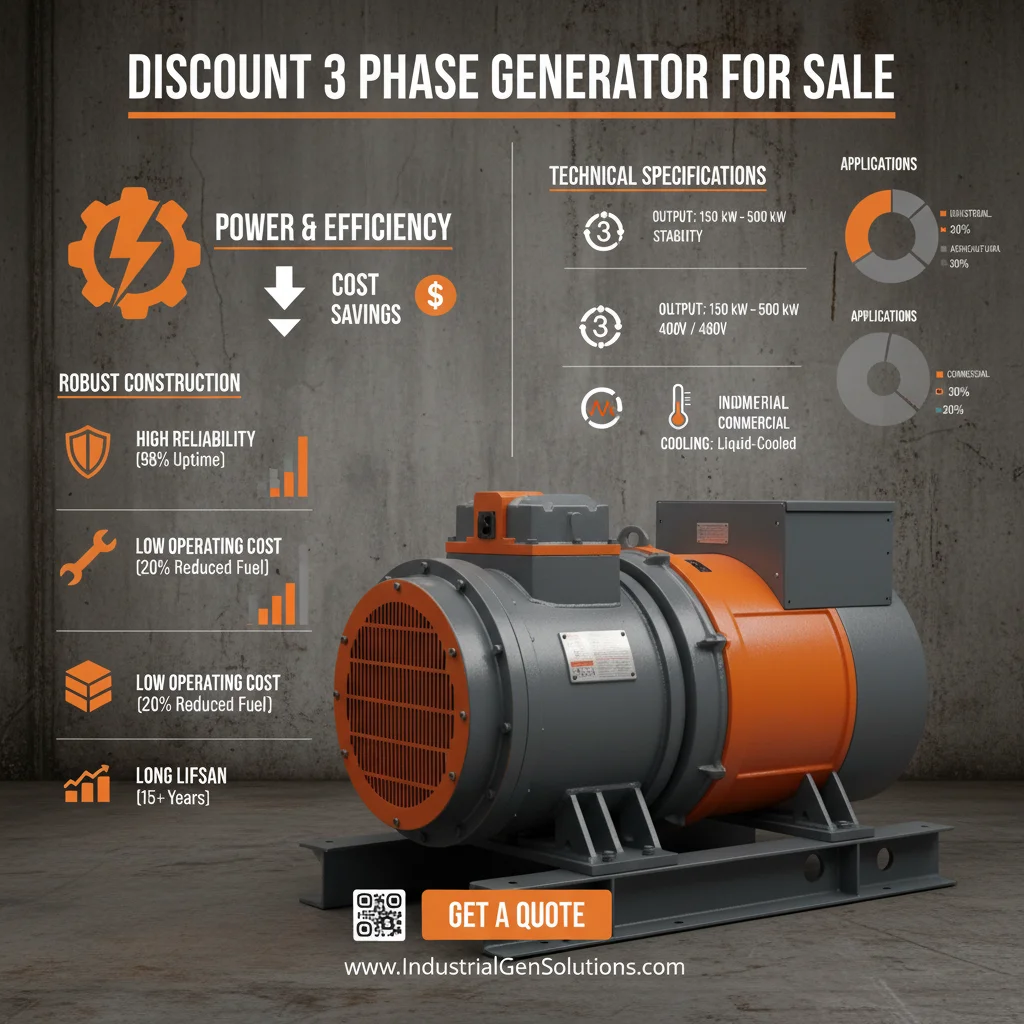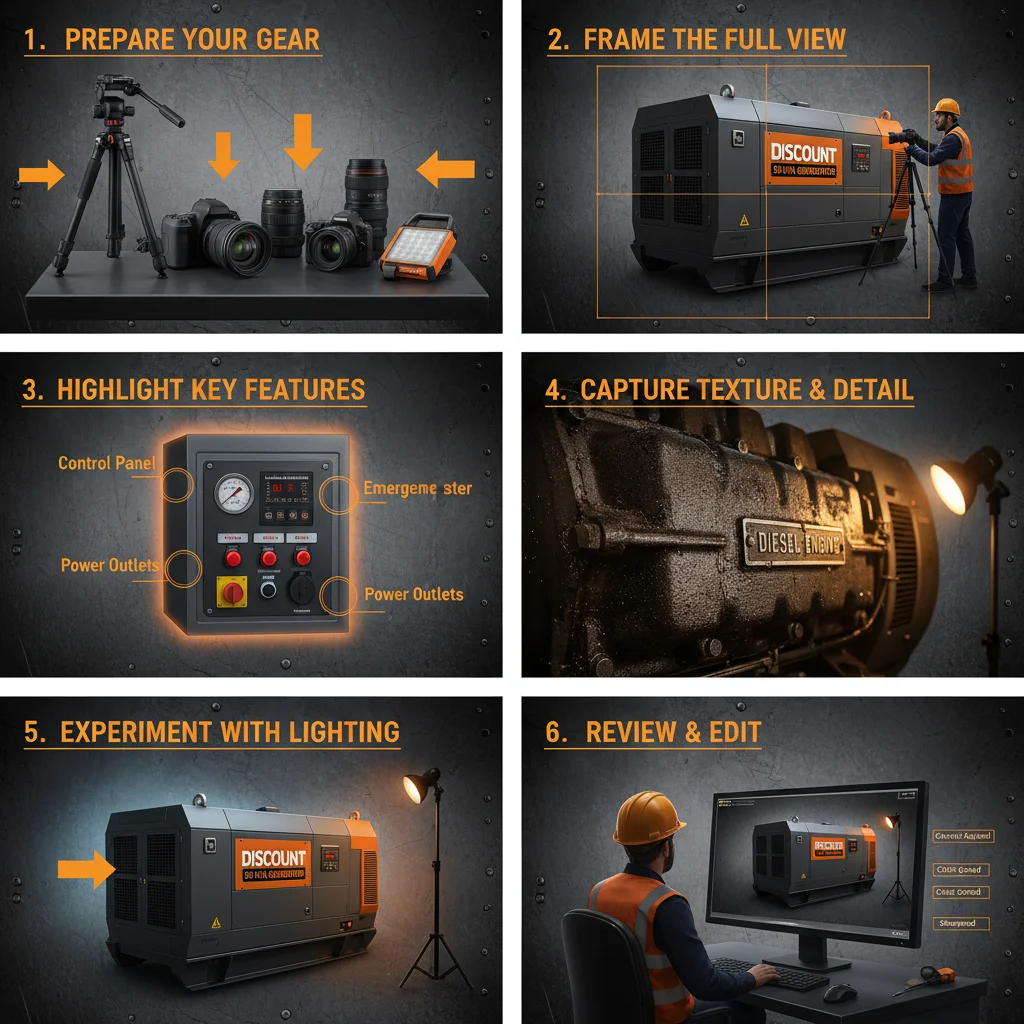
Finding a balance between initial expenditure and long-term power reliability often leads procurement managers to search for a Discount 60 kw generator. In the mid-range power segment, 60kW units serve as a critical bridge for small commercial facilities and industrial backup systems that require more than portable power but less than heavy-duty utility grids.
However, the term "discount" in the industrial power sector can be misleading. True value is not found in the lowest sticker price, but in the Total Cost of Ownership (TCO), where fuel efficiency, maintenance intervals, and engine durability intersect with the initial purchase price.
For enterprises operating in the electrical machinery and equipment manufacturing sector, selecting a 60kW power source requires a technical evaluation of load profiles and environment-specific adaptations to ensure the equipment doesn't become a liability during critical failures.

Understanding the Mid-Range 60kW Power Segment

A 60kW generator occupies a strategic position in the power range, typically serving as the primary energy source for remote offices or the standby backup for essential medical and data infrastructure. Unlike smaller residential units, these systems are designed for continuous industrial loads and often integrate sophisticated control panels for automatic voltage regulation.
When searching for a discount 60 kw generator, users are typically navigating a trade-off between "off-the-shelf" standardization and custom OEM specifications. The goal is to secure a unit that maintains high-level efficiency without the premium cost of over-engineered features that may not be necessary for the specific application.
From a manufacturing perspective, the integration of diesel or natural gas engines determines the unit's lifecycle costs. Those seeking affordability must look beyond the initial discount and analyze the engine's fuel consumption rate at 50%, 75%, and 100% load to determine the actual economic viability of the investment.
Critical Evaluation Factors for Budget Power Systems
The primary risk in procuring discounted industrial equipment is the potential compromise in component quality. In a 60kW system, the critical points of failure are typically the alternator windings, the governor stability, and the cooling system's capacity under extreme ambient temperatures.
A professional evaluation should focus on the engine brand and the certification of the alternator. For instance, utilizing premium engines like Cummins or Perkins—even in a discounted package—ensures that spare parts remain available globally and that the unit meets international emission standards such as CE or ISO.
Furthermore, the structure of the generator—whether it is an open-frame unit or a sound-attenuated canopy—significantly impacts the total cost. While open-frame units are cheaper, the cost of building a separate weatherproof enclosure often exceeds the price of a factory-integrated canopy, making the latter a more economical long-term choice.
Practical Application Scenarios for 60kW Generators
The versatility of the 60kW range allows it to be deployed across diverse sectors. In the healthcare sector, these units often power surgical wards or emergency lighting systems, where the transition time from grid failure to full power must be near-instantaneous via an AMF (Automatic Mains Failure) panel.
In agricultural settings, such as large-scale irrigation or aquaculture, 60kW generators provide the necessary torque for heavy pumps and aeration systems. In these demanding environments, the focus shifts from "discount" to "durability," requiring ruggedized air filters to handle dust and high-capacity cooling systems to prevent overheating during peak summer loads.
Commercial infrastructure, including boutique hotels or small data centers, utilizes these units for critical backup. Here, the noise footprint is a primary concern, leading many to opt for super-silent canopy models that comply with urban noise regulations while providing unwavering power stability.
Operational Efficiency and Performance Benchmarks
Evaluating the performance of a 60kW unit involves analyzing the fuel efficiency curve and the voltage stability under transient loads. A high-quality unit should maintain a steady frequency even when heavy machinery starts, preventing damage to sensitive electronics.
The following data illustrates the typical performance difference between generic budget units and optimized industrial-grade discounted generators, focusing on operational stability and fuel economy indicators.
Discount 60 kw generator Performance Metrics
As indicated, while the initial cost of optimized units may be higher, the gains in fuel efficiency and the reduction in unplanned downtime create a significantly more favorable ROI. This is particularly evident in prime power applications where the generator runs for thousands of hours annually.
Strategic Procurement and Implementation Guidelines
Procuring a 60kW generator requires more than a purchase order; it requires a site readiness plan. This includes calculating the distance from the generator to the distribution board to minimize voltage drop and ensuring a stable, vibration-dampening concrete pad is installed.
Buyers should insist on a Factory Acceptance Test (FAT) that simulates real-world load conditions. This process verifies that the "discount" hasn't resulted in a unit that fails under 100% load or one that suffers from excessive vibration during the transition to full power.
Maintenance contracts should be negotiated upfront. The ability to source filters, gaskets, and controllers quickly is more valuable than a lower initial price. Working with a manufacturer that provides comprehensive multilingual manuals and remote monitoring support can drastically reduce out-of-service time.
Future Directions in Compact Industrial Power Generation
The 60kW segment is currently evolving toward hybrid integration. We are seeing an increase in "Microgrid-Ready" generators that can operate in parallel with solar PV arrays and battery energy storage systems (BESS), allowing the generator to run only during periods of low renewable output.
Digitalization is also transforming maintenance. The shift toward IoT-enabled control panels means that fuel levels, oil pressure, and engine temperature can be monitored via smartphone apps, shifting maintenance from a reactive "break-fix" model to a proactive, predictive approach.
Environmental regulations are likely to push the market toward natural gas and hybrid diesel-electric configurations. These systems may offer lower emissions and quieter operation, making them more suitable for urban commercial environments while maintaining the reliability that diesel is known for.
Decision Matrix for Selecting 60kW Power Solutions
Choosing the right 60kW unit depends on the specific priority of the operation. A remote construction site has different needs than a metropolitan clinic. The following matrix helps procurement officers differentiate between available configurations based on their primary operational driver.
By comparing the technical approach and the cost factors, users can identify which "discount" option aligns with their risk tolerance and budget constraints.
| Solution Type | Primary Driver | Technical Approach | Maintenance Profile |
|---|---|---|---|
| Open Frame Budget | Initial Capex | Standard engine / Basic panel | High manual effort |
| Silent Canopy | Urban Compliance | Acoustic foam / Weather-proof | Standard intervals |
| Prime Power Diesel | High Reliability | Heavy-duty engine / Large tank | Rigorous scheduling |
| Natural Gas Hybrid | Fuel Economy | Gas conversion / Low emission | Specialized tech |
| Containerized Unit | Remote Deployment | Modular enclosure / HVAC | Low onsite effort |
| OEM Customized | Specific Load | Tailored alternator / AMF | Predictive/Digital |
Ultimately, the best selection is one that ensures business continuity. For those analyzing mid-range power needs, reviewing the technical capabilities available through www.gas-diesel-generators.com can provide a clearer perspective on balancing cost and performance.
Frequently Asked Questions
Conclusion
The search for a discount 60 kw generator should not be a race to the bottom, but a strategic search for the optimal price-to-performance ratio. By focusing on engine quality, structural suitability, and long-term maintenance costs, businesses can secure reliable power without overpaying for unnecessary features.
Whether providing critical backup for a healthcare facility or primary power for a remote industrial site, the right 60kW solution is one that guarantees uptime. For professional guidance on selection and factory-direct options, users can explore the detailed product ranges available at www.gas-diesel-generators.com.